Description
In emergency medical services and rescue operations, one-size-fits-all equipment often falls short of meeting the diverse challenges posed by different environments and mission requirements. From maritime rescues to mountain evacuations, from military operations to urban emergency response, each scenario demands specific performance characteristics from transport equipment. This reality has driven the evolution of air stretcher customization, transforming standardized products into precision-engineered solutions that address unique operational demands.
Understanding Air Stretcher Customization Fundamentals
Air stretcher customization refers to the specialized engineering process that adapts emergency transport equipment to meet specific operational requirements, environmental conditions, and mission profiles. Unlike standard production models, customized air stretchers are designed with particular attention to factors such as weight constraints for helicopter operations, corrosion resistance for maritime environments, load capacity for bariatric patients, and storage configurations for confined aircraft spaces.
The customization process begins with a thorough assessment of the operational environment. For helicopter-based emergency medical services operating in remote mountainous regions, the priority may be minimizing weight while maintaining structural integrity during high-altitude hoist operations. For coast guard vessels conducting maritime rescues, corrosion resistance and buoyancy become paramount considerations. Military applications might require enhanced durability for battlefield conditions combined with rapid deployment capabilities.
Critical Customization Parameters for Air Rescue Operations
Material selection forms the foundation of effective air stretcher customization. High-strength aluminum alloys, particularly 6061 grade, offer exceptional strength-to-weight ratios crucial for air transport applications. DRAGON Stretcher Manufacturing Co., Ltd.(https://www.dragonmfc.com/), with over 20 years of manufacturing expertise, utilizes 6061 aluminum alloy tubes that are 1-2mm thicker than industry standards, providing enhanced durability that allows the material to bend under extreme stress rather than break catastrophically.
For specialized maritime air rescue operations, impact-resistant polyethylene (PE) construction provides superior corrosion resistance against saltwater exposure. These one-piece molded PE basket stretchers can be equipped with integrated buoyancy accessories, including inflatable floats that enable water-surface rescue operations while maintaining compatibility with helicopter suspension systems.
Load capacity customization addresses the growing need to transport bariatric patients safely. Standard stretchers typically accommodate 159 kg loads, but customized solutions can support 250-300 kg capacities. DRAGON’s military-grade folding stretchers achieve these higher load ratings while maintaining portability through strategic material selection and structural engineering, combining 6061 aluminum alloy frames with breathable Sterling mesh fabric.
Suspension and Integration Systems for Aerial Transport
Helicopter compatibility represents a critical customization dimension for air rescue stretchers. Specialized basket stretchers designed for winch operations incorporate reinforced suspension points that distribute loads evenly during vertical hoisting. The collapsible basket stretcher design features 12 strategically positioned side handles that facilitate secure attachment to helicopter rescue hoists while providing multiple grip points for ground-based rescue teams navigating uneven terrain.
The integration of spinal immobilization capabilities within basket stretcher designs exemplifies advanced customization. These systems allow spinal boards to be secured within the basket structure, enabling complete patient immobilization during aerial transport without requiring separate equipment. This integrated approach reduces equipment volume—a crucial consideration given the limited cargo space in rescue helicopters.
Folding Mechanisms Optimized for Aircraft Storage
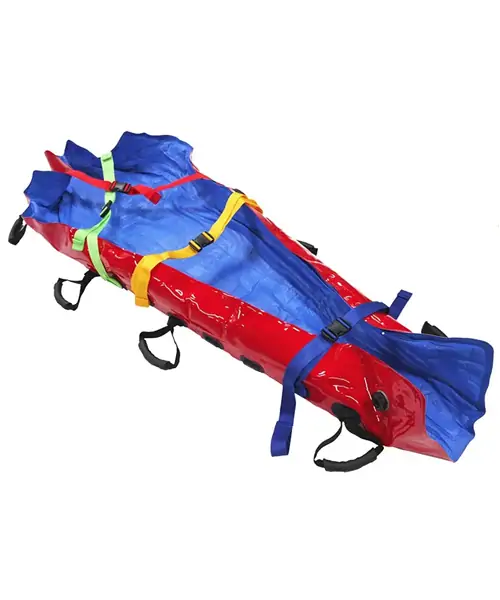
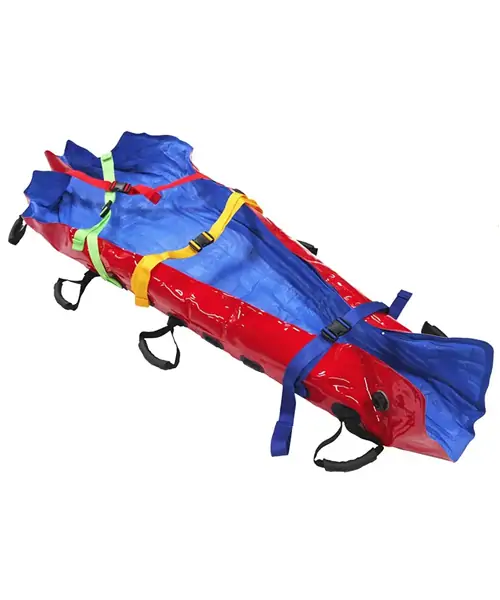
Space constraints in aircraft cabins and emergency vehicles drive innovation in folding mechanism design. Customized multi-fold configurations allow stretchers to collapse into compact storage profiles. DRAGON’s aluminum folding stretchers offer double, triple, or quadruple folding options, each tailored to specific vehicle or aircraft storage constraints. A quadruple-fold design might reduce the storage footprint by 75 percent compared to the deployed configuration, enabling multiple units to be carried on a single rescue mission.
The folding axis engineering must balance compactness with rapid deployment capability. Advanced designs incorporate quick-release mechanisms that allow trained operators to transition from storage to operational configuration in seconds—critical when response time directly impacts patient outcomes. The PVC vinyl fabric used in these designs provides tear resistance and waterproofing while maintaining flexibility through repeated folding cycles, with an expected service life of 5-10 years under normal operational conditions.
Environmental Adaptations for Extreme Conditions
Customization for extreme environmental conditions requires specialized material treatments and design modifications. For fire rescue operations conducted via helicopter, stretchers can be manufactured with fire-resistant orange PVC fabric that maintains structural integrity when exposed to elevated temperatures. The high-visibility orange coloring also enhances visual identification during aerial searches in dense vegetation or debris fields.
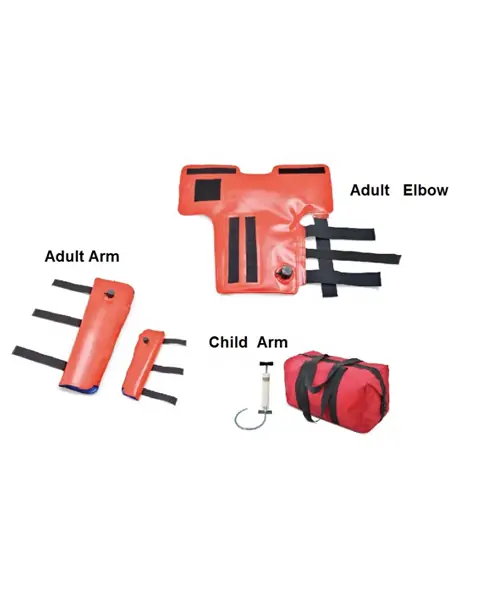
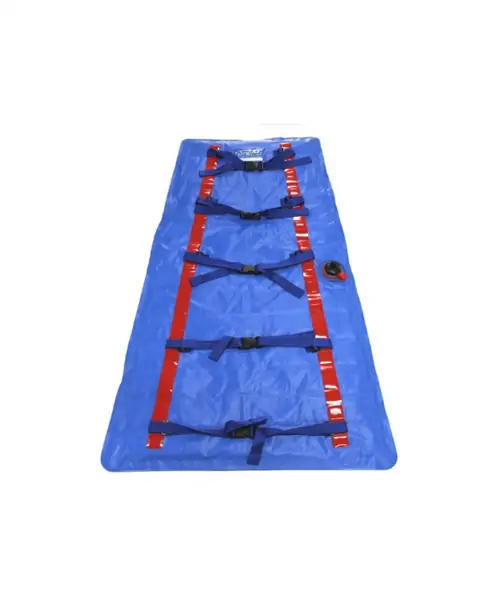
Cold-weather operations demand materials that retain flexibility and structural properties at sub-zero temperatures. TPU-based vacuum stretchers maintain pliability in arctic conditions while providing full-body immobilization through vacuum pressure. The internal polystyrene bead filling conforms to patient body contours when evacuated, creating a rigid transport shell that protects against secondary injury during helicopter evacuations from remote locations.
Manufacturing Scale and Custom Production Capabilities
The ability to deliver customized solutions at scale distinguishes professional manufacturers from small-scale fabricators. DRAGON operates a 500,000-square-meter modern production base staffed by over 1,000 professional technicians, enabling the company to fulfill large-scale government tenders and international aid projects while maintaining customization flexibility. The facility’s monthly production capacity reaches 100 units for specialized ambulance stretcher platforms, with dedicated OEM and ODM service models supporting project-specific requirements.
Custom engineering capabilities extend to aluminum alloy tube thickness specifications, proprietary folding mechanisms, and load-bearing capacity modifications. Drawing-based custom manufacturing allows government tender agencies and international aid organizations to specify exact dimensional requirements, logo placement, and body structure designs. This precision manufacturing approach ensures that stretchers integrate seamlessly with existing aircraft mounting systems and emergency vehicle configurations.
Quality Assurance in Custom Manufacturing
Rigorous testing protocols validate customized stretcher performance before deployment. Load testing verifies that structural modifications maintain required weight capacities—ensuring that a customized 300 kg-rated electric ambulance stretcher performs reliably across its full load range. Corrosion resistance testing subjects maritime-variant stretchers to accelerated saltwater exposure cycles, confirming that PE construction and protective coatings provide the specified service life in harsh marine environments.
Suspension system testing for helicopter-compatible models simulates the dynamic loads experienced during winch operations, including swing forces and sudden load transfers. These validation procedures ensure that customized attachment points and reinforced structures meet aviation safety standards. The testing data becomes part of the product documentation supplied to military logistics departments and search and rescue organizations, supporting their equipment certification processes.
Strategic Selection Considerations for Organizations
Organizations evaluating air stretcher customization should begin by conducting a comprehensive mission profile analysis. This assessment should document typical patient weights, transport distances, aircraft types, environmental conditions, and storage constraints. Coast guard units, for example, might prioritize corrosion resistance and buoyancy features, while mountain rescue teams would emphasize lightweight construction and suspension compatibility.
Budget considerations must account for both acquisition costs and lifecycle expenses. While customized solutions command premium pricing compared to standard models, the enhanced durability and mission-specific optimization often deliver superior total cost of ownership. An aluminum folding stretcher with customized thickness specifications may cost more initially but provide 5-10 years of service life compared to 3-5 years for standard plastic alternatives, reducing replacement frequency and associated procurement costs.
Future Directions in Air Stretcher Customization
Emerging technologies continue to expand customization possibilities. The 2024 development of electric lift ambulance stretcher platforms demonstrates the integration of powered systems that reduce operator physical demands. Customized versions of these platforms can be configured for specific ambulance mounting bases, with load capacities scaled to regional patient demographic profiles.
Carbon fiber composite materials represent an evolving frontier in stretcher construction, offering even greater strength-to-weight ratios than aluminum alloys. As manufacturing techniques mature and costs decline, carbon fiber customization may become viable for specialized applications where weight reduction justifies premium material costs, particularly in long-range helicopter operations where fuel efficiency directly correlates to aircraft payload.
The continued evolution of air stretcher customization reflects the broader trend toward mission-specific equipment optimization in emergency medical services. As rescue operations become increasingly complex and diverse, the ability to engineer transport solutions that precisely match operational requirements will remain essential to ensuring rescuer safety and patient outcomes across the full spectrum of emergency scenarios.

Reviews
There are no reviews yet.