Description
Overview of Self-Aligning Ball Bearings
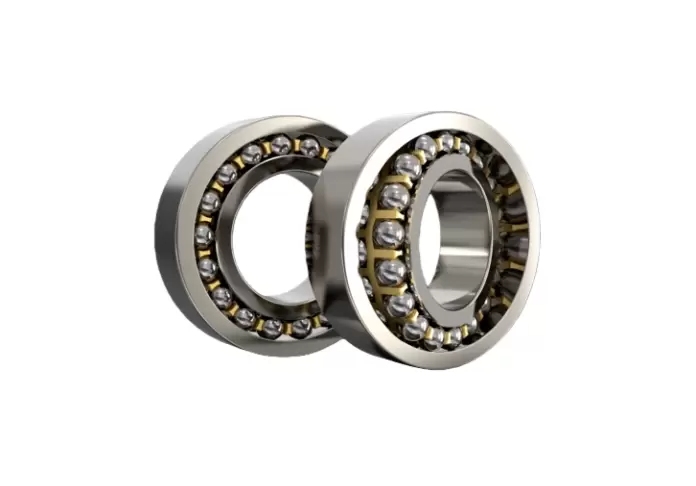
Self-aligning ball bearings are designed to automatically compensate for angular misalignment between the shaft and housing during operation. They feature two rows of balls and a concave outer ring raceway, allowing smooth adjustment even under unstable installation or shaft deflection conditions. This structure ensures stable rotation and reduces stress on mechanical components.
These bearings are widely used in medium-speed applications where vibration, load variation, or assembly deviation may occur. Their ability to maintain smooth performance under imperfect alignment makes them a reliable choice for industrial machinery systems.
Structure and Working Principle
The internal design of self-aligning ball bearings includes a double-row ball arrangement and a spherical outer raceway. This geometry allows the inner ring to adjust its position freely within a certain angular range, ensuring continuous contact between rolling elements and raceways.
This self-adjusting function reduces friction and prevents edge loading, which helps extend service life and improve operational stability. The optimized structure also reduces heat generation during rotation, supporting consistent performance in long-term use.
Performance Advantages
Self-aligning ball bearings can handle radial loads and limited axial loads in both directions. Their automatic alignment capability reduces installation accuracy requirements and minimizes maintenance adjustments.
Key advantages include low friction, smooth rotation, reduced wear, and improved resistance to vibration. These features make them suitable for equipment operating under fluctuating load conditions or structural deflection.
Technical Features
| Feature | Description |
|---|---|
| Structure | Two-row ball with spherical outer raceway |
| Function | Automatic misalignment compensation |
| Load Type | Radial load + bidirectional axial load |
| Operation | Medium-speed applications |
| Benefit | Low friction and long service life |
Applications
Self-aligning ball bearings are used in mining machinery, agricultural equipment, construction machinery, transportation systems, industrial automation, food processing equipment, power tools, and smelting industry machinery. In these fields, they help maintain stable operation despite vibration, misalignment, or heavy load conditions.
Conclusion
Self-aligning ball bearings provide an efficient solution for systems requiring high stability under misalignment and variable working conditions. Their self-adjusting structure, low friction design, and reliable load capacity make them essential components in modern industrial equipment.
Reviews
There are no reviews yet.