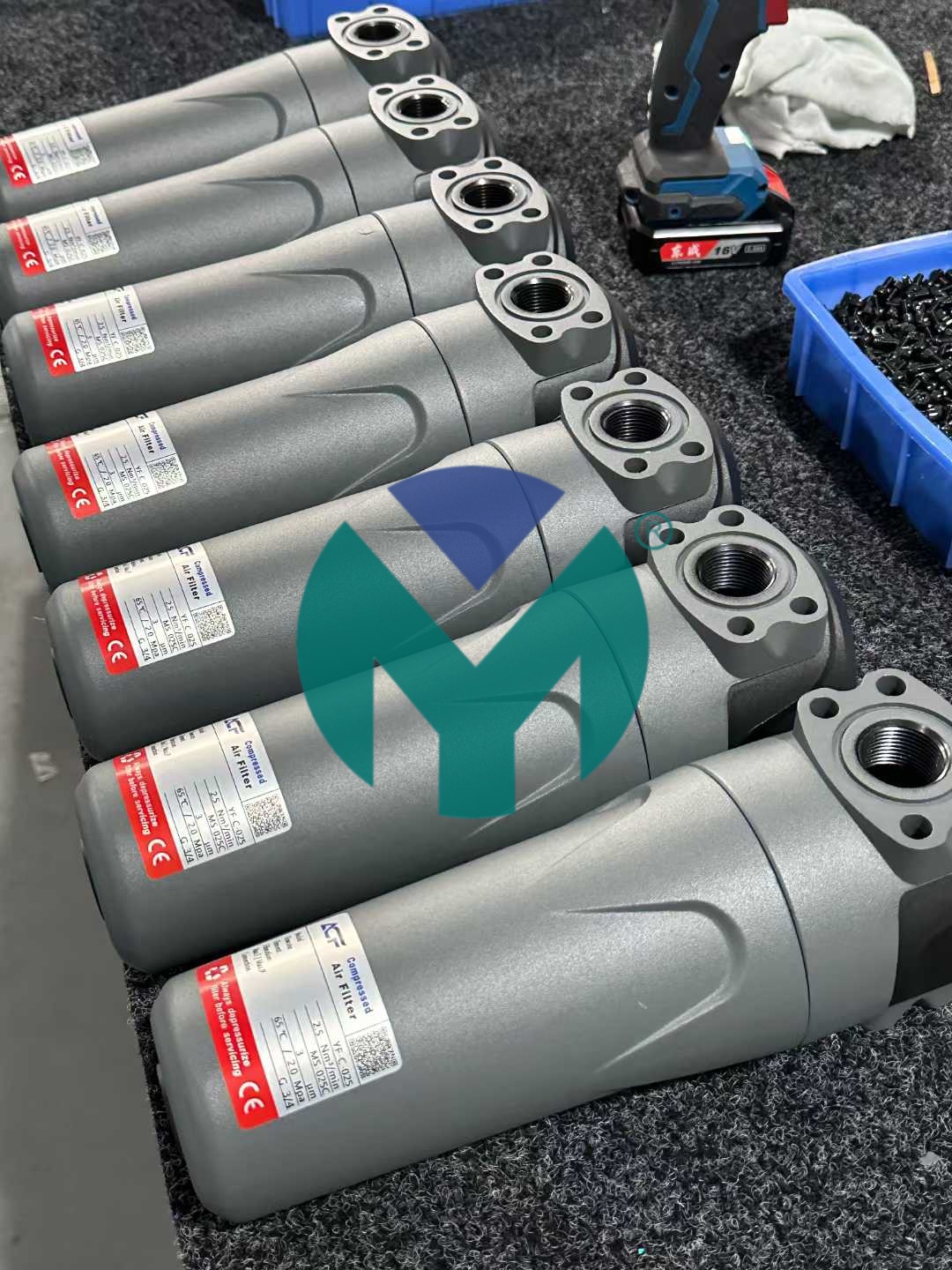
Description
Why Continuous Production Needs Consistent Filtration
In continuous manufacturing, compressed air quality is not something that can be checked only when a problem occurs. Semiconductor fabrication, pharmaceutical processing, lithium battery production, food and beverage manufacturing, and other precision industries may operate for long periods with little tolerance for oil, particles, or moisture entering the process.
From a practical selection perspective, this means compressed air filters for continuous lines need to do more than remove contaminants. They must maintain stable filtration performance while keeping pressure drop under control, withstand the operating environment, and remain available for scheduled maintenance.
Yuanmei Filtration has focused on compressed air purification since 2016, developing precision filters and filter elements for demanding industrial applications. Its experience provides several useful points for evaluating filtration equipment used in continuous production.
Filtration Accuracy Should Match the Air Quality Requirement
One of the first things I would check when selecting filtration equipment is the required compressed air quality class. Different production processes have different contamination tolerances, so using an unnecessarily fine filter can add resistance and cost, while insufficient filtration can create quality problems downstream.
Yuanmei's ACF Series provides filtration grades extending to 0.01 μm, with residual oil levels specified as low as 0.001 ppm for high-grade filtration. The company's technical information also reports particle interception efficiency of up to 99.9999% for specific filter elements.
These figures are particularly relevant when compressed air is connected directly or indirectly to sensitive manufacturing processes. However, the important point is to match the filtration grade with the required ISO 8573-1 air quality class instead of simply choosing the finest available element.
Pressure Drop Matters During Long Operating Cycles
For continuous production, pressure drop deserves the same attention as filtration efficiency. A filter may provide excellent particle removal, but excessive resistance can force the compressor to work harder to maintain downstream pressure.
This is where low-pressure-drop filter design becomes valuable. Yuanmei specifies pressure-drop performance for its ACF filtration products and develops filter elements with folded media structures designed to provide a larger effective filtration area while maintaining airflow.
The company's technical materials indicate potential energy reductions of 15–25% compared with traditional filtration designs. Actual energy performance will depend on airflow, compressor settings, operating hours, and maintenance conditions, so these factors should be evaluated using plant-specific data.
Filter Construction Needs to Follow the Environment
Continuous production lines are rarely operating under identical conditions. Temperature, pressure, moisture, chemicals, and cleaning procedures can all influence filter durability.
For standard industrial requirements, Yuanmei offers filter housings using aluminum alloy and stainless-steel construction. SUS304 and SUS316 stainless steel options can provide additional material choices where corrosion resistance and cleanliness are important.
For more demanding environments, the company also provides customized material solutions, including Hastelloy C276 and titanium configurations for specific corrosive applications. Specialized sealing solutions are available for high-temperature conditions, with certain configurations designed for temperatures up to 600°C.
This illustrates an important selection principle: the filter material should be evaluated according to the actual operating environment rather than chosen only from the standard product catalog.
Filter Elements Are Critical to Long-Term Performance
A filter housing can remain in service for years, but the filter element is normally replaced as part of routine maintenance. Therefore, element construction, availability, compatibility, and replacement cost should be considered before purchasing the complete filtration assembly.
Yuanmei develops folded precision filter elements using composite filtration media and provides replacement elements compatible with more than 30 mainstream international compressed air filter brands, according to its technical information.
For plants with existing filtration equipment, this compatibility can simplify replacement planning. It also allows maintenance teams to consider alternative replacement sources without necessarily changing the complete housing or connection arrangement.
Verification Is More Useful Than Specification Alone
When reviewing compressed air filters for continuous lines, I would not rely solely on numbers printed in a catalog. Test methods and quality-control procedures provide additional information about whether the specified performance can be consistently achieved.
Yuanmei's compressed air testing laboratory is equipped with an oil content analyzer, particle counter, and dew point sensor for evaluating air quality. Its production quality process includes raw material inspection, online testing, and finished-product verification covering pressure resistance, leakage, and filtration efficiency.
The company also reports 1,000-hour continuous operation aging tests for sampled batches. For applications involving sterile or highly controlled air, requesting relevant test documentation before purchasing can make supplier comparison much more objective.
Customization Becomes Important in Specialized Production
Standard filtration products are suitable for many industrial applications, but continuous production lines sometimes have requirements that cannot be addressed by a standard configuration.
Flow rate, pressure rating, connection type, housing material, filtration precision, sealing method, and temperature resistance may all need to be adjusted. Yuanmei provides customized filtration precision from 0.01 μm to 100 μm and flow-rate configurations from 0.1 to 100 m³/min according to its supplied technical information.
High-pressure versions are also available, with certain filter elements and assemblies designed for pressures reaching 80 bar. For engineering projects, discussing these parameters with the supplier before ordering can prevent compatibility issues during installation.
What I Would Check Before Purchasing
My approach to evaluating compressed air filters for continuous lines would start with the production requirement rather than the filter model. First, determine the required ISO 8573-1 air quality class and identify the main contaminants that need to be removed.
Next, confirm airflow, working pressure, temperature, connection dimensions, and available installation space. After that, compare filtration efficiency and pressure drop together rather than considering either specification independently.
I would also check the availability of replacement elements, expected service life, material compatibility, testing documentation, certifications, and delivery capability. These details become increasingly important when filtration equipment is connected to production that cannot easily tolerate unexpected maintenance.
Building a More Reliable Filtration Strategy
The main lesson from continuous production is that filtration should be treated as a long-term operating requirement rather than a one-time equipment purchase. Clean compressed air, controlled pressure drop, durable materials, verified performance, and accessible replacement elements all contribute to stable operation.
Yuanmei Filtration combines precision filters, replacement elements, high-pressure configurations, customized materials, and in-house testing capabilities. For manufacturers reviewing filtration options, this provides a useful reference point for assessing whether a supplier can support both the initial installation and the maintenance requirements that follow.
Ultimately, the right filtration approach is the one that maintains the required air quality without creating unnecessary energy consumption or maintenance complexity. For continuous production, that balance is what makes compressed air filtration a dependable part of the manufacturing process.
Reviews
There are no reviews yet.