Description
Product Overview
Xylenesulfonic Acid Sodium Salt is an aromatic sulfonate compound widely used as a hydrotrope and formulation ingredient in various industrial and specialty chemical applications. Also known as sodium xylenesulfonate or sodium dimethylbenzenesulfonate, this compound combines an aromatic hydrocarbon structure with a water-soluble sulfonate group, giving it useful properties in aqueous chemical formulations.
With the CAS number 1300-72-7, its molecular formula is C8H9NaO3S and its molecular weight is 208.21 g/mol. It is commonly supplied as a mixture of isomers, with variations in the positions of the methyl groups on the aromatic ring. This structural variation does not change its general classification as an aromatic sulfonate salt.
Xylenesulfonic acid sodium salt is particularly valued for its ability to improve the compatibility of certain organic ingredients with water. This makes it useful in formulations containing surfactants, solvents, and other components that may otherwise exhibit limited miscibility.
Chemical Structure and Functional Characteristics
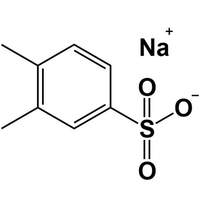
The molecular structure of sodium xylenesulfonate consists of a dimethyl-substituted benzene ring connected to a sulfonate group, which is associated with a sodium counterion. The aromatic portion contributes to its organic chemical characteristics, while the ionic sulfonate group supports its interaction with aqueous environments.
This combination gives xylenesulfonic acid sodium salt its characteristic hydrotropic behavior. Rather than functioning primarily as a conventional surfactant, it can help increase the apparent solubility of certain poorly water-soluble organic substances in aqueous formulations.
Its performance depends on concentration, temperature, formulation composition, and the chemical characteristics of the ingredients being combined. These factors should be evaluated when developing products that require improved ingredient compatibility and formulation stability.
Applications as an Industrial Hydrotrope
One of the most important applications of sodium xylenesulfonate is its use as a hydrotrope in industrial cleaning and detergent formulations. Certain organic ingredients, including fragrances, solvents, and selected surfactants, may have limited solubility in water. Adding an appropriate hydrotrope can help improve their distribution within an aqueous formulation.
In liquid detergent manufacturing, xylenesulfonic acid sodium salt can help maintain a more uniform formulation by supporting the incorporation of different organic components. It may also help reduce phase separation and improve the handling characteristics of concentrated cleaning products.
Its application is relevant to household cleaners, industrial detergents, institutional cleaning products, and other water-based formulations. The required concentration should be determined through formulation testing to achieve the desired compatibility without unnecessarily increasing the total dissolved material.
Role in Surfactant and Detergent Formulations
Surfactant compatibility is an important consideration when manufacturing liquid cleaning products. Formulations often contain multiple ingredients with different polarity and solubility characteristics, making it difficult to maintain a consistent appearance and physical stability.
Sodium xylenesulfonate can serve as a formulation aid by improving the compatibility of selected ingredients in aqueous systems. It is particularly useful in formulations where concentrated surfactants or organic solvents need to be incorporated into water-based products.
Depending on the formulation, it may help improve product clarity, reduce undesirable separation, and support consistent liquid processing. However, the final effect depends on the surfactant combination, electrolyte concentration, and other formulation variables.
Benefits in Industrial Cleaning Products
Industrial cleaning formulations frequently require a balance between cleaning performance, ingredient compatibility, and physical stability. Xylenesulfonic acid sodium salt can contribute to this balance by helping incorporate selected organic ingredients into aqueous products.
Its hydrotropic properties may support the formulation of concentrated cleaners, multipurpose detergents, and specialty cleaning liquids. It can also be considered when manufacturers need to adjust the compatibility of solvents and surfactants without significantly changing the overall formulation design.
| Application Area | Formulation Function | Potential Benefit |
|---|---|---|
| Liquid detergents | Hydrotrope | Improved ingredient compatibility |
| Industrial cleaners | Solubilizing aid | Better incorporation of organic components |
| Household cleaning products | Formulation aid | Improved formulation uniformity |
| Surfactant formulations | Compatibility support | Reduced phase separation |
| Specialty chemical products | Hydrotropic ingredient | Improved aqueous formulation performance |
Formulation Compatibility and Usage Considerations
The effectiveness of xylenesulfonic acid sodium salt depends on the overall chemical environment. Manufacturers should evaluate its compatibility with anionic, nonionic, and other suitable surfactant types before introducing it into a production formulation.
Concentration is another important factor. Excessive addition may affect viscosity, electrolyte balance, or other physical properties. For this reason, laboratory trials are recommended to determine an appropriate dosage for each formulation.
Temperature, pH, solvent selection, and the presence of other salts can also influence the final performance. A structured formulation evaluation helps manufacturers identify suitable addition levels and maintain consistent product characteristics during scale-up.
Product Specifications and Quality Control
For chemical manufacturers and industrial buyers, verifying product identity and quality is essential before purchasing sodium xylenesulfonate. The CAS number, active matter content, moisture level, appearance, and relevant impurity limits should be checked against the agreed product specifications.
Because this material is commonly supplied as a mixture of isomers, its exact isomer distribution may depend on the manufacturing process and product grade. Buyers should review the supplier's technical documentation to understand the applicable specifications.
| Product Property | Information |
|---|---|
| Product Name | Xylenesulfonic Acid Sodium Salt |
| CAS Number | 1300-72-7 |
| IUPAC Name | Sodium 3,4-dimethylbenzenesulfonate |
| Molecular Formula | C8H9NaO3S |
| Molecular Weight | 208.21 g/mol |
| Synonyms | Sodium Xylenesulfonate, Sodium Dimethylbenzenesulfonate |
| Product Type | Aromatic Sulfonate Salt |
Storage, Handling, and Procurement
Proper storage and handling help maintain the quality of sodium xylenesulfonate during transportation and use. The product should be stored in compatible, tightly sealed packaging under the conditions specified by the supplier. Buyers should consult the Safety Data Sheet for appropriate protective equipment, handling precautions, and storage recommendations.
For industrial procurement, important considerations include product grade, active matter content, packaging specifications, batch consistency, and delivery arrangements. A batch-specific Certificate of Analysis (COA) can help buyers verify that the supplied material meets their purchasing requirements.
Zhejiang Kingvolt provides a contact point for customers sourcing specialty chemicals and industrial formulation ingredients. Buyers interested in xylenesulfonic acid sodium salt can communicate their intended application, quality requirements, order quantity, and packaging preferences to clarify suitable procurement specifications.
Frequently Asked Questions
What is xylenesulfonic acid sodium salt used for?
It is primarily used as a hydrotrope in detergents, industrial cleaners, and aqueous chemical formulations to improve the compatibility and solubility of selected organic ingredients.
Is sodium xylenesulfonate a surfactant?
It is generally classified as a hydrotrope rather than a conventional surfactant. Its main formulation role is to improve the solubility and compatibility of other ingredients.
What is the CAS number of sodium xylenesulfonate?
The CAS number is 1300-72-7, which is commonly used for product identification and chemical procurement.
Can xylenesulfonic acid sodium salt be used in liquid detergents?
Yes. It is commonly used as a hydrotropic ingredient in liquid detergent formulations to support ingredient compatibility and formulation uniformity.
What should buyers consider when sourcing this chemical?
Buyers should confirm active matter content, moisture level, product appearance, impurity specifications, packaging, and batch-specific quality documentation before ordering.